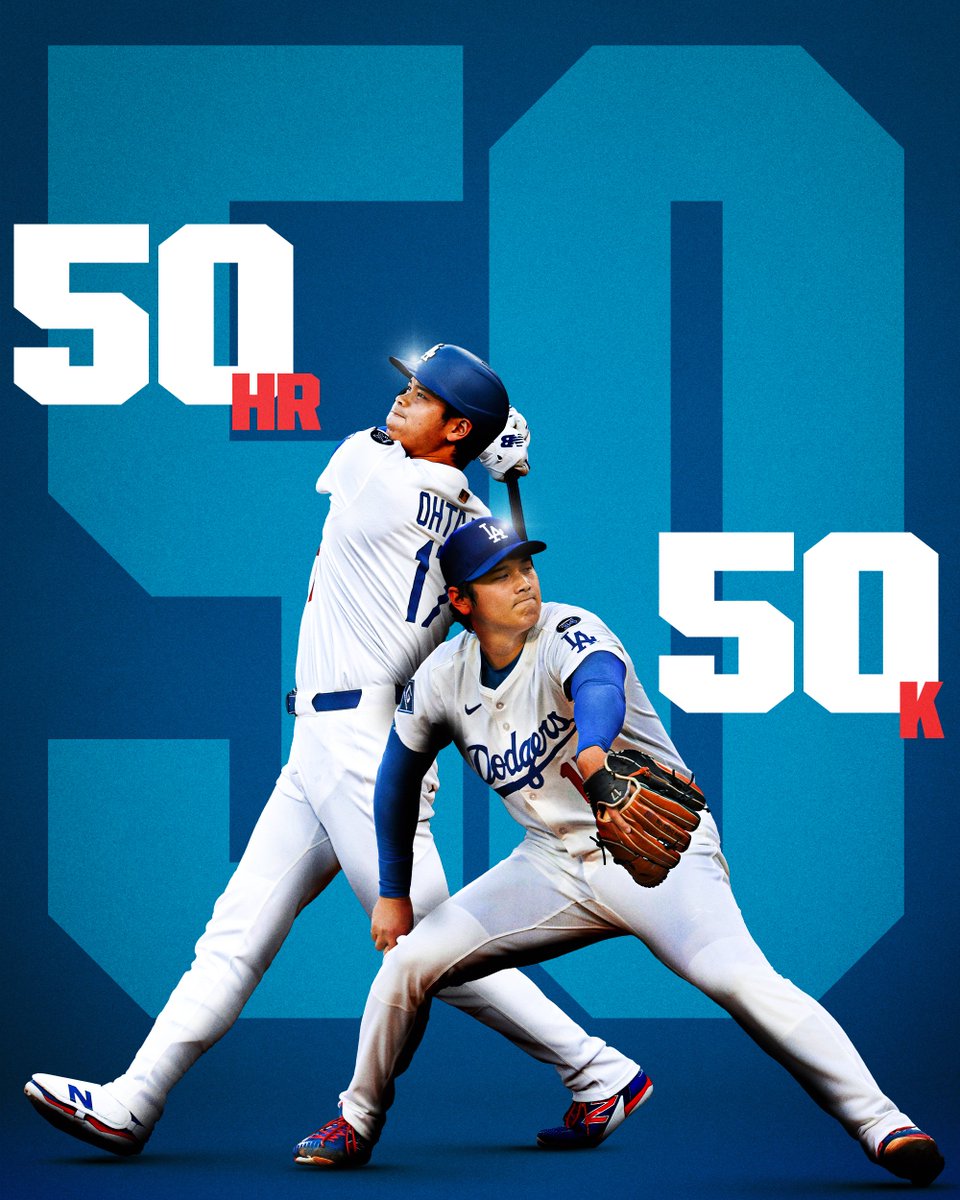
Shohei Ohtani Makes History as First MLB Player With 50 Home Runs and 50 Strikeouts in a Season
A Night to Remember in Philadelphia
On a cool September evening at Citizens Bank Park, baseball history was made. In front of a crowd that buzzed with anticipation, Los Angeles Dodgers superstar Shohei Ohtani launched his 50th home run of the season, a towering solo shot in the eighth inning against the Philadelphia Phillies. The moment alone would have been monumental — Ohtani joined the rarefied group of players to hit 50 home runs in consecutive seasons, a feat accomplished only by legends such as Babe Ruth and Mark McGwire.
But what made his achievement unprecedented was what he had done just hours earlier: taking the mound and striking out his 50th batter of the season after five dominant, no-hit innings. No player in the long history of Major League Baseball had ever combined that level of offensive and pitching output in the same year. For Ohtani, a player who has consistently defied baseball’s traditional limits, the “50–50 season” instantly became one of the sport’s defining milestones.
The First-Ever “50–50” Season
Ohtani’s line on the night underscored the breadth of his talent. His strikeouts brought his season total on the mound to 50, and his late-game home run elevated him into new statistical territory that no player — not Ruth, not Aaron, not Bonds — has reached before. Baseball, a sport defined by meticulous record-keeping and comparisons across eras, thrives on milestones. Players have chased the magic numbers of 500 home runs, 3,000 hits, and 300 strikeouts for generations. Yet Ohtani’s dual mastery created a new standard, one born not of specialization but of unprecedented versatility.
When asked about the milestone, Dodgers manager Dave Roberts described Ohtani’s achievement with understated awe, noting that “it’s hard to even contextualize because there’s no comparison in the modern game.” Opposing players, too, found themselves marveling at the performance, with Phillies starter Zack Wheeler remarking that “you game-plan against him as a pitcher and as a hitter, and now he’s doing things nobody thought possible.”
A Continuation of Baseball’s Rich History
The feat resonates even more deeply when set against the backdrop of baseball’s long history. Babe Ruth, often called the greatest two-way player, abandoned regular pitching duties by the time he began setting home run records. Since then, pitchers and hitters have largely traveled separate paths, as the rigors of the game and its evolving strategies discouraged hybrid roles.
In the late 20th century, sluggers like Sammy Sosa and Mark McGwire defined seasons with their home run chases. In parallel, pitchers such as Randy Johnson and Pedro Martínez electrified fans with sheer strikeout dominance. But a player embodying both storylines simultaneously had been unthinkable — until Ohtani emerged.
By becoming not only the sixth player to hit 50 homers in consecutive seasons, but the first to couple it with meaningful strikeout numbers as a pitcher, Ohtani has placed himself in a statistical tier that evokes comparisons to legends across multiple disciplines of the game. He is writing a chapter in baseball history that scholars and fans will reference for decades.
Impact on the Los Angeles Dodgers
While the Dodgers ultimately fell to the Phillies in a 9-6 loss, Ohtani’s performance overshadowed the outcome. For Los Angeles, the dual-threat player has become more than a generational talent — he represents a transformational presence on and off the field.
The Dodgers, already a perennial powerhouse, invested heavily in Ohtani during a period of intense competition in the National League. His contract brought sky-high expectations, not only in terms of his offensive production but also in shaping the team’s identity. With Ohtani in the lineup, Los Angeles continues to draw some of the largest crowds in baseball, while merchandising sales tied to his name dominate the league.
Although the Dodgers are chasing another deep postseason run, Ohtani’s latest milestone promises to remain a defining highlight regardless of October outcomes. It is an achievement that transcends wins and losses, etching its place in baseball lore.
Global Significance
Ohtani’s standing in the game resonates well beyond the United States. As Japan’s most celebrated athlete, his performances spark immense pride across his home country. Fans in Tokyo celebrated his 50th home run with live broadcasts at public viewing events, underscoring his role as a cultural ambassador for the sport.
Baseball remains one of the most popular sports in Japan, and Ohtani’s journey from Hokkaido’s Nippon-Ham Fighters to MLB superstardom has become a modern epic. His ability to dominate in both pitching and hitting reflects an almost mythic quality in Japanese media, which portrays him as the embodiment of diligence, discipline, and limitless potential.
This cross-Pacific fandom has also elevated Major League Baseball itself. With Ohtani’s every at-bat and pitch drawing international coverage, MLB benefits from a global spotlight rivaling that of the NBA and soccer’s major leagues, expanding the game’s reach to audiences that might otherwise remain outside its traditional strongholds.
Economic and Cultural Impact
Ohtani’s “50–50” achievement has immediate economic implications for baseball and beyond. Ticket demand surges around Dodgers games whenever he is both scheduled to pitch and likely to appear at the plate. Broadcasters benefit as well, with viewership spikes recorded during Dodgers contests compared to baseline averages for other nightly games.
Sponsorship deals tied to Ohtani reach far beyond the baseball diamond. Multinational brands across technology, apparel, and beverage industries have aligned themselves with his image, amplifying revenue streams for both the player and the organizations around him. Analysts estimate that Ohtani generates hundreds of millions of dollars in related economic activity annually, a remarkable number for a single athlete in a team sport.
Additionally, his performance fuels conversations about how teams build rosters. In an era when specialized roles dominate, Ohtani proves the commercial and competitive value of versatility. Whether he inspires a new wave of two-way players or remains a singular phenomenon, his influence is reshaping both scouting philosophies and fan expectations.
Comparisons Across Eras
Baseball thrives on comparison, and Ohtani’s season inevitably invites reflection on how his achievements stack up against past legends. Babe Ruth built his reputation first as a pitcher before transitioning to an iconic slugger, but the game’s demands prevented him from excelling simultaneously at both.
Players such as Bo Jackson and Deion Sanders captured imaginations with their two-sport abilities in baseball and football, but they never approached the high-level output Ohtani sustains in both pitching and hitting. Even contemporary giants like Aaron Judge or Jacob deGrom are defined by their mastery in a single discipline.
What makes Ohtani unique is not only his statistical output but also his consistency across multiple seasons. Back-to-back years of 50 or more home runs prove his power-hitting prowess, while his ability to sustain elite pitching performance distances him even further from comparison.
The Future of Ohtani’s Legacy
At just 31 years old, Ohtani appears to be entering the prime of his career, with multiple years ahead to extend his place in the record books. Yet questions linger regarding the physical toll such a workload imposes. Pitching at the major-league level demands arm durability, and hitting with power requires a different set of physical strengths. Balancing both over the long term will be a test unlike any faced by his predecessors.
Still, for now, Ohtani stands as baseball’s defining figure of the era, a fusion of Ruth’s mythology and modern athletic science. His 50–50 season captures not just statistical brilliance but the essence of why fans adore sport — witnessing the seemingly impossible become reality.
Public Reaction to the Historic Moment
Across social media and in stadiums nationwide, Ohtani’s historic night dominated conversation. Fans showered him with praise, calling the season “the greatest ever witnessed by a two-way player.” Highlights of his home run and strikeouts spread rapidly worldwide, ensuring that his milestone was celebrated far beyond Philadelphia.
For Dodgers fans, who have already seen their share of iconic moments in one of baseball’s most storied franchises, Ohtani adds a chapter that will be remembered as singular. The sellout crowd at Citizens Bank Park may not have gone home with a win for their team, but they departed with the memory of witnessing history firsthand.
Conclusion
Shohei Ohtani’s achievement of 50 home runs and 50 strikeouts in the same season redefines what is possible in Major League Baseball. It is an accomplishment that transcends statistics, evoking comparisons to the game’s greatest legends while carving out uncharted territory for its future. Baseball is a sport steeped in tradition, where numbers often define legacy. Yet with Ohtani, the game now has a precedent that defies traditional classification and sets a new gold standard for excellence.
In carving this unprecedented path, Ohtani has not only secured his place in baseball history but also elevated the sport to new cultural and global heights. Whether he can sustain such brilliance across future seasons remains to be seen, but the reality is undeniable: the 2025 “50–50 season” belongs to Shohei Ohtani, and it will resonate for generations to come.