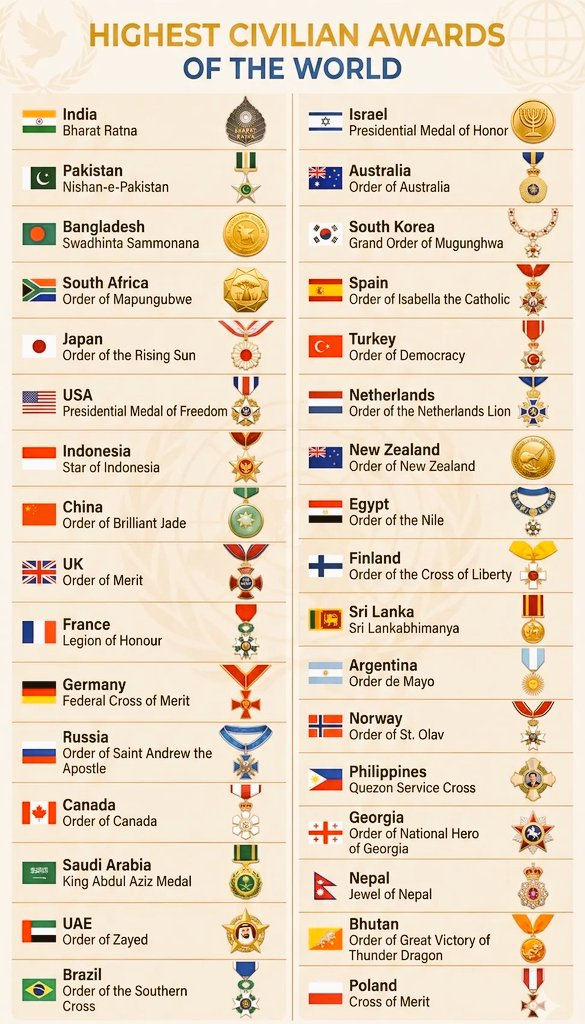
Highest Civilian Honors Worldwide: A Comprehensive Overview of the World’s Most Prestigious Awards
Across nations, civilizations have long honored individuals whose work, courage, or service elevates society. The highest civilian awards function as compact narratives of national values, historical memory, and collective aspirations. This article surveys a broad spectrum of these prestigious honors from diverse regions, outlining their origins, eligibility criteria, notable recipients, and the economic and cultural impact they exert both domestically and globally. By placing these awards in historical context and examining regional comparisons, we gain a clearer picture of how civilian excellence is recognized, celebrated, and leveraged to inspire future generations.
Historical context: the evolution of civilian honors Civilian awards emerged from the need to acknowledge extraordinary achievement outside military valor. Early recognitions often drew from royal patronage or state ceremony, signaling a citizenry’s capacity to contribute to the public good. Over time, many nations formalized their honors, creating structured orders and medals with clear eligibility criteria and posthumous considerations. The trajectory typically moves from ad hoc honors to highly organized systems that reflect contemporary values—innovation, humanitarianism, leadership, scientific achievement, arts, diplomacy, and public service. As societies globalize, these awards increasingly serve dual roles: affirming national narratives and projecting soft power through international visibility.
Global perspectives on top civilian decorations
- India: Bharat Ratna The Bharat Ratna stands as India’s supreme civilian award, conferred for exceptional contributions in the arts, literature, science, public service, and beyond. Established in 1954, the award honors individuals whose work has profoundly influenced national life. Recipients often embody a fusion of intellectual achievement and public service, reflecting India’s commitment to inclusive development, social equity, and cultural heritage. The award is typically announced by the President and presented in a national ceremony, underscoring its ceremonial gravitas and symbolic resonance across the country.
- Pakistan: Nishan-e-Pakistan Pakistan’s Nishan-e-Pakistan is the highest order awarded in recognition of distinguished service to the country. Institutions named after national identity, history, or sovereignty anchor such honors, which are traditionally reserved for individuals whose actions have significantly advanced Pakistan’s interests. The award’s prestige stems from its rarity and the high selectivity of its recipients, often including leaders, diplomats, or figures whose work has shaped regional stability, development, or humanitarian outcomes.
- United States: Presidential Medal of Freedom The Presidential Medal of Freedom is the United States’ highest civilian decoration. It honors a broad spectrum of contributions to the nation and humanity, including civic leadership, scientific breakthroughs, cultural achievement, and humanitarian service. Established to recognize acts that transcend ordinary achievement, the award reinforces democratic values, resilience in times of challenge, and the importance of public service. Recipients typically reflect a wide array of disciplines, mirroring the country’s diverse tapestry of achievement.
- Japan: Order of the Rising Sun Japan’s Order of the Rising Sun has long symbolized rays of enlightenment and national renewal. It recognizes individuals who have made outstanding contributions to Japan’s culture, economy, governance, or international relations. The award’s evolution mirrors Japan’s postwar modernization and globalization, with recipients spanning science, education, industry, and diplomacy. Its prestige is enhanced by the ceremony’s formal traditions and the weight of Japan’s ceremonial framework.
- South Africa: Order of Mapungubwe South Africa’s Order of Mapungubwe honors visionary leadership and outstanding achievements that have uplifted the national or regional community. Established after the end of apartheid, the award reflects the country’s ongoing effort to recognize inclusive growth, reconciliation, and cultural renaissance. Recipients often demonstrate a blend of civic leadership, entrepreneurship, and social impact.
- China: Medal of the Republic China’s Medal of the Republic is among the country’s most esteemed civilian decorations. It highlights individuals who have contributed significantly to national development, scientific progress, or cultural advancement. The award’s prominence is tied to China’s rapid development trajectory and its emphasis on achievements that align with national priorities, including technology, industry, and public welfare.
- France: Légion d’honneur France’s Légion d’honneur is one of the oldest and most widely recognized orders of merit in the world. Established during the French Revolution, it honors exemplary service to France and humanity across military and civilian spheres. Its prestige transcends national borders, with recipients from all continents illustrating France’s historical influence on ideas such as liberty, equality, and fraternity.
- Australia: Order of Australia Australia’s Order of Australia celebrates extraordinary contributions to the nation’s social, cultural, and economic fabric. The award recognizes achievements across a broad range of fields, including community service, science, arts, and public administration. It reflects Australia’s emphasis on egalitarian values, social cohesion, and the importance of volunteerism and civic engagement.
- Bhutan: Order of the Druk Gyalpo Bhutan’s Order of the Druk Gyalpo embodies the country’s unique blend of spiritual tradition and modern nation-building. The honor recognizes service to the kingdom, development, and the promotion of Gross National Happiness—Bhutan’s distinctive development philosophy. It highlights how cultural and philosophical frameworks influence the design and symbolism of civilian awards.
Economic impact and public reception The highest civilian awards exert tangible and intangible effects on economies and societies. Economically, they can influence philanthropy, fundraising for charitable causes, and sponsorship of cultural or scientific programs linked to recipients. Award ceremonies often generate media attention, tourism, and locally oriented business engagement, particularly when ceremonies occur in capitals or historic cities. The public reception of these honors can reinforce civic pride, encourage youth to pursue science, arts, or public service, and motivate corporate social responsibility initiatives aligned with national development goals.
Regional comparisons reveal nuanced patterns. In some countries, civilian honors are closely tied to political leadership or state projects, while in others they function as technocratic recognitions of excellence. The balance between merit-based selection and public diplomacy varies, shaping how the awards are perceived domestically and abroad. In emerging economies, the attention given to civilian awards serves as a signal of stable governance and a commitment to human capital development, which can attract investment and global collaboration.
Notable patterns and case studies
- Cross-border influence: Several awards, such as the Légion d’honneur and the Presidential Medal of Freedom, have educated and inspired figures globally. Recipients often become symbolic bridges between nations, fostering cultural exchange and bilateral cooperation in science, arts, and governance.
- Post-conflict and reconciliation: Awards established during transitional periods frequently aim to promote unity. South Africa’s Order of Mapungubwe is an example of how a society uses ceremonial recognition to honor leadership that supports reconciliation, economic inclusion, and social reform.
- Science and innovation emphasis: Awards like India’s Bharat Ratna and China’s Medal of the Republic highlight a trend toward acknowledging scientific and technological leadership as central to national progress. These recognitions can influence research funding priorities and private sector investment in innovation ecosystems.
- Cultural leadership and heritage: National honors often celebrate cultural custodians, artists, authors, and educators who preserve language, history, and creative expression. France’s Légion d’honneur, for instance, has deep historical roots in promoting civil society and cultural exchange alongside civic duty.
Regional comparisons: implications for policy and development
- South Asia: A cluster of high civilian honors emphasizes a mix of public service, scientific achievement, and cultural leadership. These awards encourage inclusive development and social equity, aligning with regional growth priorities and demographic realities.
- East Asia: Recognition in Japan and China reflects a balance between modernization and tradition. These awards promote international collaboration while reinforcing national narratives around innovation, education, and responsible governance.
- Africa and the global south: Awards like the Order of Mapungubwe and other regional honors underscore post-colonial development trajectories, governance reforms, and social cohesion. They can act as catalysts for inclusive growth and regional integration.
- Europe and the Atlantic world: France’s Légion d’honneur and similar orders demonstrate enduring influence in diplomacy, culture, and humanitarian work. These awards often accompany international partnerships, research alliances, and cross-cultural education programs.
Public reaction and cultural significance Public reaction to top civilian honors often reflects national mood and social priorities. When recipients are widely celebrated for humanitarian work, scientific breakthroughs, or remarkable leadership, ceremonies become moments of collective pride and inspiration. Media coverage tends to highlight the recipients’ life stories, the barriers overcome, and the potential implications for future generations. Critics may question political motivation or selectivity, but the overarching narrative usually emphasizes merit, service, and the advancement of human progress.
Looking ahead: evolving definitions of civilian excellence As societies face new challenges—from climate change to artificial intelligence governance and public health crises—the criteria for civilian honors may evolve. Future awards could emphasize resilience, adaptability, interdisciplinary collaboration, and ethical leadership in technology and data stewardship. The best honors will likely maintain a clear, merit-based selection process while remaining inclusive and globally minded, recognizing contributions that improve lives across diverse communities.
Key takeaways
- The world’s highest civilian awards reflect a shared aspiration: to recognize extraordinary contributions that strengthen society, culture, and knowledge.
- Historical context helps explain why nations value these honors, and regional comparisons reveal how different political and cultural environments shape criteria and symbolism.
- Economic and social impacts extend beyond prestige, influencing philanthropy, policy priorities, and public motivation for public service and innovation.
- A global perspective shows how awards can foster cross-border collaboration, cultural exchange, and regional development, while sustaining national stories about progress and resilience.
Notes on method and sources This overview synthesizes widely reported information about prominent civilian honors from multiple countries, focusing on the highest distinctions and their roles within national narratives. While each award operates within its own constitutional, ceremonial, and cultural framework, common threads emerge around merit, service, and the advancement of human welfare. For readers seeking deeper details on individual awards, official government announcements and established reference works provide authoritative histories, eligibility criteria, and lists of notable honorees.
In the long arc of history, civilian honors remain a barometer of a nation’s values and a beacon for future achievement. They remind societies that exceptional contributions—whether in science, education, diplomacy, or community service—are worth recognizing, preserving, and learning from as new generations carry forward the work of progress.