Controversial Video Featuring Prominent U.S. Lawmakers Sparks Debate Over Political Motives and Historical Echoes
Lawmakers Under Scrutiny After Video Release
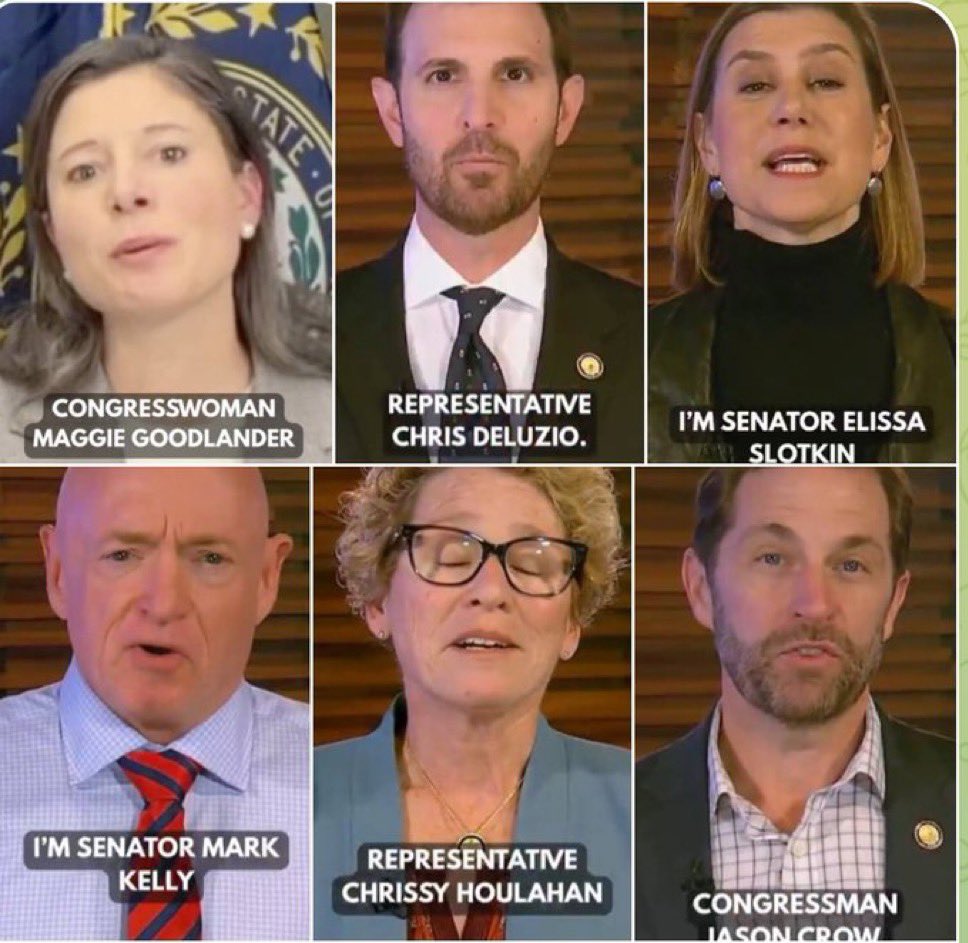
A recently circulated video featuring a group of U.S. lawmakers has ignited intense debate across political, academic, and media circles. The footage, which includes Congresswoman Maggie Goodlander, Representative Chris Deluzio, Senator Elissa Slotkin, Senator Mark Kelly, Representative Chrissy Houlahan, and Congressman Jason Crow, has become the focal point of online and televised discussions.
Critics and commentators have questioned the timing and tone of the video, arguing that it appears designed to signal organized opposition ahead of the incoming Trump administration’s inauguration. Supporters of the lawmakers, however, contend that the footage merely highlights calls for unity, democratic integrity, and civic engagement.
Released during a moment of heightened national tension, the video quickly polarized audiences and prompted discussions on the role of political messaging, statecraft, and influence in democratic societies.
The Footage and Its Claims
The video, which surfaced on social media platforms earlier this week, shows the six lawmakers delivering coordinated remarks centered on democracy, resistance to authoritarianism, and civic vigilance. Although the content of their statements appeared rooted in broad democratic principles, the synchrony and delivery fueled speculation that the effort may have been choreographed to invoke or inspire political mobilization.
Political analysts noted that the visual framing, tone, and rhetoric resembled messaging strategies historically associated with movements abroad, often termed “color revolutions” — popular uprisings that emerged in post-Soviet states and other regions seeking reforms through protest and civic organization.
While the lawmakers’ offices have not issued a unified statement regarding the video’s intent, several aides have dismissed claims of coordinated subversion, calling such allegations “extreme misinterpretations” of a message “focused on transparency and constitutional accountability.”
Comparisons to Historical Movements
References to "color revolutions" — such as those in Georgia (2003), Ukraine (2004 and 2014), and Kyrgyzstan (2005) — reflect global awareness of how public mobilization campaigns have influenced political transitions. Analysts cautious about drawing direct parallels argue that the U.S. political environment, grounded in firmly established institutions and electoral mechanisms, differs significantly from transitional societies where those movements occurred.
Still, the comparisons hold symbolic weight. In both cases, periods of civic unrest and uncertainty have been marked by competing narratives over legitimacy and representation. The new video, released weeks before the formal transfer of power, lands squarely in that historical tradition — a flashpoint in the ongoing struggle between public rhetoric and institutional stability.
Heightened Political Tensions Ahead of the Transition
The timing of the video coincides with an atmosphere of volatility in Washington and across the nation. With former President Donald Trump preparing to return to office after a divisive election cycle, numerous government agencies, advocacy groups, and private institutions have been bracing for policy realignments.
Observers note that both supporters and opponents of the incoming administration are reasserting their positions, framing the coming months as critical to the future of domestic governance and global engagement. The lawmakers featured in the video represent a centrist-to-moderate wing within their respective parties, known for prior work on national security, veterans’ affairs, and democratic reforms. Their collective appearance, however, has led some to question whether a new intra-party bloc is forming in anticipation of political shifts.
Though there is no official indication of such coordination, the perception alone has intensified scrutiny.
Public Reaction and Media Coverage
Public response to the video has been swift and divided. On major social media platforms, hashtags related to the footage trended within hours of its release. Supporters praised the lawmakers for demonstrating moral clarity at a time of political uncertainty. Critics, on the other hand, accused them of staging a symbolic opposition effort that undermines the legitimacy of an elected administration.
Cable networks and digital outlets offered extensive coverage, with talk shows and podcast hosts dissecting both the tone and potential subtext of the lawmakers’ speeches. While some commentators emphasized the importance of free expression and civic leadership, others warned that such displays could deepen polarization during an already fragile transition period.
Expert Analysis on Messaging and Perception
Specialists in political communication suggest that the controversy underscores how visual media can shape public narratives within hours. The structure of the video — featuring lawmakers known for service backgrounds and bipartisan reputations — was likely intended to convey credibility and continuity, said multiple analysts.
However, symbolic gestures can be interpreted differently depending on context. When democratic rhetoric emerges against the backdrop of leadership change, especially one involving a highly polarizing figure, interpretations often diverge sharply between audiences predisposed to suspicion and those inclined toward trust.
Political historian Dr. Amanda Wilkins of Georgetown University noted that such imagery carries deep resonance in periods of uncertainty. “When citizens perceive institutions under strain, leaders often invoke moral or patriotic themes to reaffirm civic identity. The danger lies in over-interpretation — mistaking solidarity for sedition or vice versa,” she said.
Economic and Foreign Policy Implications
The ramifications of political turbulence extend beyond symbolic debates. Economists have flagged that moments of uncertainty — particularly during transitions between administrations — can influence investor sentiment, market volatility, and international confidence. Though the video itself may not trigger immediate economic effects, its appearance amid policy speculation adds to the perception of a divided political environment.
Business leaders and foreign investors closely track such developments, viewing them as barometers of policy continuity and predictability. The United States remains the world’s largest economy, and any hint of institutional instability can ripple through financial markets and diplomatic channels.
Foreign policy experts also note that allies and competitors alike monitor internal U.S. political dynamics. When American lawmakers appear fragmented or engaged in visible dissent, it can embolden adversarial states or complicate coalition-building in international arenas.
Reactions from U.S. Allies and Analysts Abroad
Several international observers have weighed in, often drawing upon recent global experiences with political messaging and social media activism. European commentators, particularly in nations that experienced social movements linked to democratic reform, warned against sensational comparisons but acknowledged the symbolic potency of U.S. lawmakers’ gestures.
In Eastern Europe, local media outlets recalled early 2000s civic movements, emphasizing that political transformation rarely follows predictable trajectories once public emotions are engaged. In Asia and the Middle East, analysts framed the video as evidence of democratic durability — citizens and legislatures freely expressing dissent without fear of repression.
Others took a cautious view, suggesting that such displays could be exploited by adversaries seeking to depict the U.S. as politically unstable.
Constitutional Context and Institutional Resilience
American political history offers numerous examples of tension during transfers of power — from the contested election of 1876 to the protests of the Vietnam era and the transition after 2020. Each episode tested the resilience of constitutional mechanisms but ultimately reaffirmed their capacity to absorb shocks without collapse.
The present controversy follows a similar pattern. Despite vivid rhetoric and intense media focus, the underlying institutions remain intact. The video’s release may highlight the emotional intensity of the current moment, but experts emphasize that American democracy has repeatedly balanced dissent, reform, and continuity.
Looking Ahead
As the incoming administration prepares to take office, attention is shifting from speculation to policy. Lawmakers across both chambers face urgent issues — foreign conflicts requiring new diplomatic strategies, domestic economic challenges, and efforts to restore public faith in governance.
In that context, the video may fade into the background as a fleeting controversy, or it could stand as a harbinger of deeper political realignment. Much will depend on whether the participants and their colleagues continue to engage in coordinated messaging or pivot toward bipartisan legislative priorities once the new administration assumes power.
Regardless of interpretation, the episode underscores a recurring truth in American political life: moments of stress often reveal not only the fragility of consensus but also the endurance of democratic discourse.
The weeks leading up to inauguration day promise more developments as both political camps prepare for the challenges ahead. What remains clear is that, once again, the power of imagery, rhetoric, and timing has thrust a handful of lawmakers into the center of a national debate about democracy’s meaning and its future trajectory.