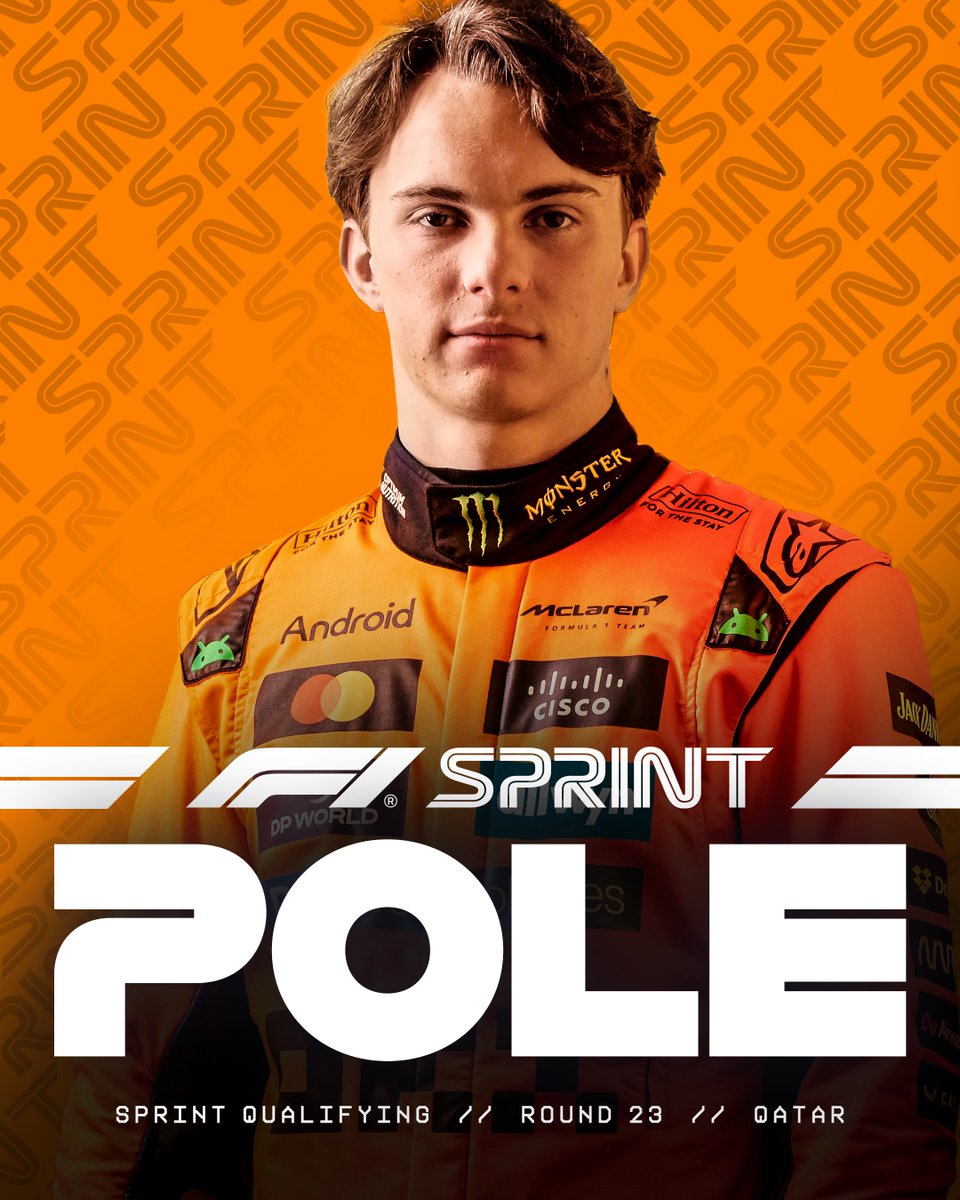
Oscar Piastri Claims Sprint Race Pole at Qatar Grand Prix After Stunning Qualifying Performance
Rising Star Shines in Lusail Night Qualifying
Under the brilliant floodlights of Lusail International Circuit, Oscar Piastri delivered a commanding performance to seize pole position for the sprint race at the Qatar Grand Prix. The McLaren driver, in his debut season, showcased precision and composure during a tricky qualifying session that tested even the most seasoned Formula 1 drivers. His achievement marks another milestone in his rapidly ascending career, confirming his growing reputation as one of the sport’s brightest young talents.
The result comes as Round 23 of this year’s Formula 1 championship enters its final stretch, with teams locked in a tense battle for the remaining points. Piastri’s strong qualifying run not only positions him favorably for the sprint but also underscores McLaren’s remarkable form during the back half of the season.
A Hard-Fought Session Under Desert Conditions
Qualifying in Qatar is always a demanding affair, with shifting track temperatures and gusty desert winds adding complexity to the already narrow window for tire performance. The Lusail circuit, returned to the F1 calendar after a hiatus, features a high-speed layout known for its sweeping corners and prolonged full-throttle sections.
Piastri managed to maintain calm amid the chaos of the shortened sprint qualifying format, setting his best lap time on the final run of SQ3. His pace placed him ahead of a tightly packed field that saw the top six drivers separated by less than three-tenths of a second. Both Red Bull and Ferrari drivers struggled to extract consistent performance from their tires, allowing McLaren to capitalize with precision timing and a well-executed setup strategy.
Team engineers described the conditions as “knife-edge,” with track evolution playing a crucial role. Even the smallest misstep on the dust-laden circuit could spell the difference between pole position and the midfield. Piastri’s ability to keep his lap clean under pressure drew praise from across the paddock.
McLaren’s Steady Climb Back to the Front
For McLaren, this pole position continues a resurgence that began midway through the season after a major update package revitalized their performance. The British team, once struggling to find grip and top speed, has emerged as a consistent podium contender across recent rounds.
Just months ago, McLaren languished in the constructors’ standings, battling for minor points while Red Bull and Ferrari appeared untouchable. The turnaround began with improvements introduced at the Austrian and British Grands Prix, followed by a steady accumulation of podiums through the summer races. Now, with Piastri and teammate Lando Norris both finding confidence in the car, the team’s momentum is unmistakable.
McLaren’s technical director credited the engineers’ adaptability to the car’s new aerodynamic balance, noting that Lusail’s high-speed sections reward precision rather than brute force. As a result, the orange and papaya machines have found harmony between straight-line speed and corner stability—an asset that paid dividends under the night lights of Qatar.
Historical Context: The Young Driver’s Ascent
Oscar Piastri’s pole position further cements the legacy of Australia’s newest F1 hopefuls. Since entering the sport, Piastri has consistently impressed with his race craft and maturity far beyond his age. His composure under pressure recalls the early career stages of drivers like Lewis Hamilton and Charles Leclerc, who also demonstrated early flashes of championship potential in their debut seasons.
The achievement also revives memories of McLaren’s storied past in Qatar, where the team first showcased its modern competitive revival during the sport’s inaugural Lusail race seasons ago. With this pole, Piastri joins an elite group of McLaren drivers who have scored top spots in qualifying sessions at new or challenging circuits, maintaining the legacy once defined by legends such as Ayrton Senna, Mika Häkkinen, and Fernando Alonso.
For Australia, Piastri’s performance represents a significant milestone. Since Daniel Ricciardo’s victories earlier in the decade, no Australian has managed to feature so prominently on the front grid in consecutive events. Piastri’s pole rekindles national pride and enthusiasm among fans eager to see their compatriot succeed at the sport’s highest level.
Competitive Field Sets Stage for Intense Sprint
The Qatar sprint format, a condensed shootout that determines additional championship points and sets tone for the main race, is expected to produce high-intensity action from the first corner. Piastri’s nearest challengers—expected to include drivers from Red Bull, Mercedes, and Ferrari—will be fully aware that overtaking is difficult on Lusail’s flowing layout, making the start crucial.
Race engineers predict tire degradation will play a decisive role, as the circuit’s abrasive surface and warm night air combine to punish aggressive driving. Teams that manage their soft compound tires effectively could gain a significant edge during the 19-lap sprint race.
While Piastri starts from the coveted pole position, maintaining it will demand a flawless getaway and calm under relentless pressure. Teammate Lando Norris, starting just behind the front runners, could provide strategic support, though both McLaren drivers will be eager to maximize individual points in the constructor race.
Economic and Global Interest Grows Around Qatar Grand Prix
Beyond the on-track drama, the Qatar Grand Prix has become one of the Middle East's most economically strategic motorsport events. The nation has invested heavily in infrastructure, hospitality, and circuit development, aiming to secure a lasting position on the Formula 1 calendar. The Lusail venue, originally designed for MotoGP, has been reconfigured with state-of-the-art facilities that reflect Qatar’s broader ambitions to become a hub for international sporting events.
Since hosting its first Formula 1 race, Qatar has leveraged the event to boost tourism, attract foreign investment, and enhance its global profile. The Grand Prix now routinely draws large crowds from across the region, rivaling attendance figures from neighboring circuits in Saudi Arabia, Bahrain, and Abu Dhabi. The influx of fans and teams fuels the local economy, particularly through the hospitality, transport, and luxury sectors.
Economists note the ripple effect: hotels reach full capacity weeks before race weekend, restaurants and retailers benefit from increased international footfall, and the country’s visibility as a destination for high-end events grows. Despite global inflation and fluctuating oil prices, Formula 1’s expansion into the Gulf continues to show financial resilience.
Comparison with Regional Circuits
When compared with other Middle Eastern venues, Lusail’s circuit distinguishes itself through its smooth surface and sweeping design philosophy. Bahrain International Circuit favors sharp braking zones and heavy acceleration, producing close battles, while the Jeddah Corniche Circuit in Saudi Arabia stands out for its rapid chicanes and close barriers that punish mistakes. Lusail, with its broad corner profiles and full-throttle sections, rewards aerodynamic efficiency and precise handling—qualities McLaren appears to have mastered.
Another difference is atmospheric. Bahrain’s desert sunrise races highlight endurance under heat, while Qatar’s night setting provides dramatic visuals under floodlights. This aesthetic appeal contributes to global broadcasts and social media engagement, driving record levels of online interaction and viewership. Motorsport analysts project that Qatar’s status will continue to rise if the nation maintains strong fan engagement, logistical efficiency, and consistent track performance feedback from teams.
Reactions from the Paddock and Fans
As news of Piastri’s pole lap spread through the paddock, drivers and team principals offered a mix of respect and curiosity. Red Bull’s camp, dominant for much of the season, acknowledged that McLaren’s pace represents one of the biggest threats to their supremacy in months. Ferrari and Mercedes, meanwhile, signaled they would review data overnight to close the gap before the sprint.
Fans, both at the track and online, celebrated Piastri’s achievement with enthusiastic support. In the stands, McLaren flags waved proudly as the Australian’s name flashed on the timing screens. On digital platforms, social media trends quickly centered around his performance, marking a surge in engagement not only for McLaren but also for Formula 1 as a global spectacle.
Preview of the Weekend Ahead
The sprint race promises a thrilling prelude to Sunday’s main Grand Prix, where strategy, tire wear, and track evolution will all come into sharper focus. Teams are expected to conduct overnight analyses of tire data, with Pirelli indicating that medium compounds may play a crucial role during longer stints.
If Piastri converts his pole position into victory, he would join a rare category of drivers who have won a sprint from pole in their debut season—a feat that could significantly boost his standing in both the driver and constructor championships. Conversely, a single error or poor start could reset the weekend, opening the door for rivals eager to seize control before the full-distance race.
Regardless of the outcome, the Qatar Grand Prix solidifies its reputation as one of the sport’s most captivating new additions, blending energy, spectacle, and technical mastery amid the desert night. As engines roar beneath the Lusail lights, all eyes now turn to whether Oscar Piastri’s remarkable rise will continue—or if tomorrow’s sprint will rewrite the story once again.