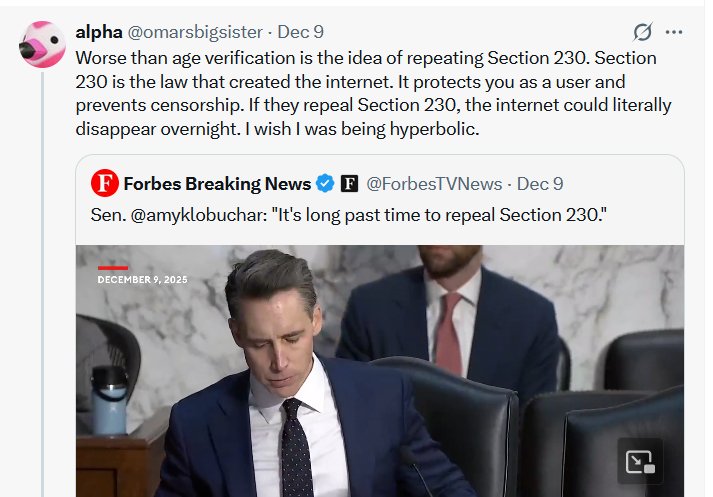
Senator’s Call to Repeal Section 230 Raises Fears for Future of User-Generated Content
Lawmaker Targets Core Internet Liability Shield
A prominent U.S. senator has called for the full repeal of Section 230 of the Communications Decency Act, a move that legal experts, technology companies, and digital rights advocates say could radically reshape — or even dismantle — the modern internet built on user-generated content.
The senator’s remarks, delivered this week during a public forum on online harms and platform accountability, framed Section 230 as an outdated legal shield that allows large social media companies to evade responsibility for harmful, illegal, or misleading content posted by users. The proposal reignited a long-simmering debate over the balance between online safety, corporate accountability, and free expression.
Critics of repeal warn that removing Section 230 without a viable replacement could trigger sweeping changes to how platforms such as Twitter, Instagram, YouTube, TikTok, Reddit, and smaller community forums operate. Some legal scholars caution that, in its most extreme form, repeal could effectively end the open, participatory internet that has developed over the last three decades.
What Section 230 Does and Why It Matters
Enacted in 1996, Section 230 was designed to encourage the growth of internet services while addressing concerns about offensive or illegal content. The provision, often summarized as “the twenty-six words that created the internet,” states that online platforms are not treated as the publisher or speaker of content posted by their users. This means that, in most cases, websites and apps cannot be held legally liable for user-generated posts, comments, videos, or reviews.
At the same time, Section 230 gives companies legal room to moderate content — for example, to remove spam, hate speech, or explicit material — without being treated as publishers making editorial decisions in the traditional media sense. This dual protection is widely viewed as the legal foundation that allowed social media platforms, online marketplaces, review sites, and discussion forums to expand rapidly.
Without this liability shield, platforms could face lawsuits for defamation, harassment, privacy violations, or other claims based on what millions or billions of users post every day. For large platforms, that would mean an enormous increase in legal risk and compliance costs. For smaller websites, it could be existential.
Fears of Widespread Censorship and Platform Closures
The senator’s call for repeal has sparked alarm among free-speech advocates and technology policy experts, who warn that eliminating Section 230 could have the opposite effect of what some critics intend. Rather than forcing platforms to host more speech, they argue, it might prompt companies to drastically restrict what users can say or share.
Faced with potential liability for each piece of user content, platforms would likely adopt aggressive moderation policies. Legal analysts say companies might:
- Remove potentially controversial political posts by default.
- Block or heavily restrict comments on news stories, videos, and public profiles.
- Limit live streaming features that are harder to moderate in real time.
- Ban entire categories of user-generated content that pose legal risks.
Major platforms with deep financial resources could invest in expansive moderation and legal departments, but smaller platforms, niche forums, and startups might find the risks unsustainable. Some might shut down their interactive features entirely, while others might never launch in the first place.
Digital rights groups warn that such an environment could lead to a “chilling effect” on speech, as platforms err on the side of removal to avoid potential lawsuits. Critics describe this scenario as a form of preemptive censorship, driven not by government orders but by private risk calculations in a more hostile legal landscape.
Economic Stakes for the Digital Ecosystem
The potential economic impact of repealing Section 230 is significant. The current model of user-generated content supports a broad ecosystem that includes social networks, video platforms, online marketplaces, crowdsourced review services, creator economy tools, and countless independent blogs and forums.
Advertising, subscription models, and creator monetization programs all rely on a constant flow of user posts, videos, images, and comments. Tech industry analysts note that:
- Influencers and creators depend on video and social platforms to reach audiences and earn revenue from ads, sponsorships, and fan support.
- Small businesses use user-generated reviews and social media engagement to reach customers at a fraction of traditional marketing costs.
- Startups frequently build new services that integrate or rely on user-generated interactions, from education platforms to hobbyist communities.
If platforms became far more restrictive or stopped hosting user-generated content altogether, that ecosystem could contract. Advertising revenue tied to user content might decline, creator incomes could fall, and many small or medium-sized companies built around community interaction could struggle to survive.
While some advocates of repeal argue that tighter liability rules would simply push platforms to invest more in safety and moderation, industry groups warn the cost burden would be uneven. Larger firms might adapt, but innovation could slow if new entrants cannot afford the legal risk of hosting user content.
Historical Context: How Section 230 Shaped the Modern Web
To understand the current debate, many legal historians point back to the early days of the commercial internet. In the mid-1990s, courts were grappling with how to treat online services that hosted messages from users. One key concern was that if a company tried to moderate any content at all, it might be treated like a traditional publisher — and thus be fully liable for anything it missed.
Section 230 emerged as a compromise. Lawmakers wanted to encourage responsible moderation while avoiding a scenario in which platforms simply refused to moderate to escape liability. The provision enabled early forums, bulletin boards, and portals to experiment with user communities without facing newspaper-level legal exposure.
In the decades since, courts have interpreted Section 230 broadly in many cases, reinforcing its role as a foundational statute for internet services. This legal stability helped foster the explosive growth of social media in the 2000s and 2010s, as well as the rise of user-driven platforms in areas such as travel, retail, and hospitality.
However, the same protections have drawn criticism amid a surge of concerns over misinformation, online harassment, extremist content, and the spread of harmful or illegal material. That tension sets the stage for today’s calls to reevaluate, reform, or repeal the law.
Safety Versus Free Expression at the Center of the Debate
The senator’s recent comments highlight a core question: how to balance online safety and accountability against the principles of free expression and open discourse.
Supporters of repeal argue that platforms have failed to sufficiently police harmful content. They point to cases involving cyberbullying, non-consensual imagery, fraud, and extremist propaganda as evidence that companies have not used their legal flexibility responsibly. For these critics, the threat of increased liability could push platforms to invest more heavily in content moderation, safety tools, and proactive detection systems.
Opponents acknowledge the seriousness of these harms but contend that full repeal is a blunt instrument that could undermine the fundamental benefits of the internet. Instead of expanding safety, they say, it could drive legitimate discussions, citizen journalism, and marginalized voices offline if platforms decide that open forums are too risky to maintain.
Civil liberties organizations emphasize that user-generated platforms have become critical spaces for community building, political organizing, and cultural expression. They warn that if companies respond to higher liability by restricting speech, the impact could fall disproportionately on smaller creators, activists, and independent publishers who lack alternative outlets.
Regional and International Comparisons
The United States’ approach to platform liability is not universal. As the debate over Section 230 intensifies, observers often point to other regions to understand how different legal frameworks shape the online environment.
In the European Union, regulations such as the e-Commerce Directive and the more recent Digital Services Act impose a “notice and takedown” style system. Under this approach, platforms are generally not liable for user content they do not know about, but once notified of illegal material, they must act swiftly to remove it or face potential legal consequences. New rules also require large platforms to conduct risk assessments and provide greater transparency about their algorithms and moderation practices.
Countries like Germany have introduced additional laws targeting certain types of harmful content, such as hate speech, with strict timelines for removal. Critics say these laws can encourage platforms to over-remove content to avoid penalties, raising concerns about overreach and restrictions on legitimate speech.
Other nations, including some in Asia and Latin America, have experimented with different models, imposing varying degrees of liability and governmental oversight. In several cases, heightened liability has coincided with more aggressive content takedowns, while in others it has led platforms to limit certain services or withdraw from smaller markets.
Analysts note that if the United States were to repeal Section 230 entirely, it would represent one of the most dramatic shifts in platform liability among major economies. The change could also have ripple effects for global internet policy, as regulators elsewhere watch how the U.S. model evolves.
No Immediate Legislative Action, But Rising Pressure
Despite the forceful rhetoric, no specific legislation to repeal Section 230 has yet advanced in Congress. The senator’s remarks add to a growing chorus of voices across the political spectrum calling for changes to the law, but there is little consensus on what should replace it or how reforms should be structured.
Over the past several years, lawmakers have introduced multiple bills that would modify Section 230, targeting areas such as child exploitation, antiterrorism efforts, and platform transparency. Some proposals seek to condition liability protections on meeting certain moderation standards, while others would carve out narrow exceptions rather than eliminating the shield entirely.
Policy experts say that crafting a replacement framework is a complex task. Any new law would need to define what types of content trigger liability, which entities are covered, and how to account for the scale and speed of digital communication. It would also face constitutional scrutiny, particularly around the First Amendment and the role of private companies in moderating speech.
For now, the senator’s call appears more likely to influence public discourse and future legislative negotiations than to produce immediate legal change. However, the renewed attention underscores how central Section 230 has become in discussions about the future of the internet.
Public Reaction and Industry Response
Public reaction to the senator’s proposal has been swift and divided. On social media platforms themselves, users debated whether repeal would curb online abuse or break the services they depend on for news, entertainment, and community.
Some users, especially those who have faced harassment or targeted campaigns, expressed support for stronger legal tools to hold platforms accountable. Others warned that the loss of user-generated spaces would harm activists, independent artists, small business owners, and everyday people who rely on digital platforms to connect and share their work.
Technology companies have not issued a unified statement in response to the remarks, but trade organizations representing the industry have historically defended Section 230 as essential to the functioning of the internet. They argue that existing laws, combined with platform policies and law enforcement tools, already provide mechanisms to address serious abuses.
Legal scholars and policy researchers, meanwhile, have urged a measured approach. Many advocate for targeted reforms that increase transparency, encourage better safety practices, and clarify gray areas without dismantling the core protections that make large-scale user-generated content feasible.
An Uncertain Future for the Online Public Square
As the debate over Section 230 intensifies, one point of agreement among many stakeholders is that the stakes are unusually high. The law underpins the architecture of the online public square, from global social media networks to niche message boards.
Repealing Section 230 outright, as the senator has urged, would represent a historic turning point. It could lead to more aggressive policing of harmful content and greater accountability in some areas, but it could also usher in a more constrained and cautious digital environment, where platforms limit speech and innovation to manage legal exposure.
With no immediate legislative action on the horizon, the current moment is one of heightened scrutiny rather than imminent change. Yet the renewed push for repeal ensures that the future of user-generated content, and the internet as it has been known for a generation, will remain at the center of national and international policy debates in the months and years ahead.