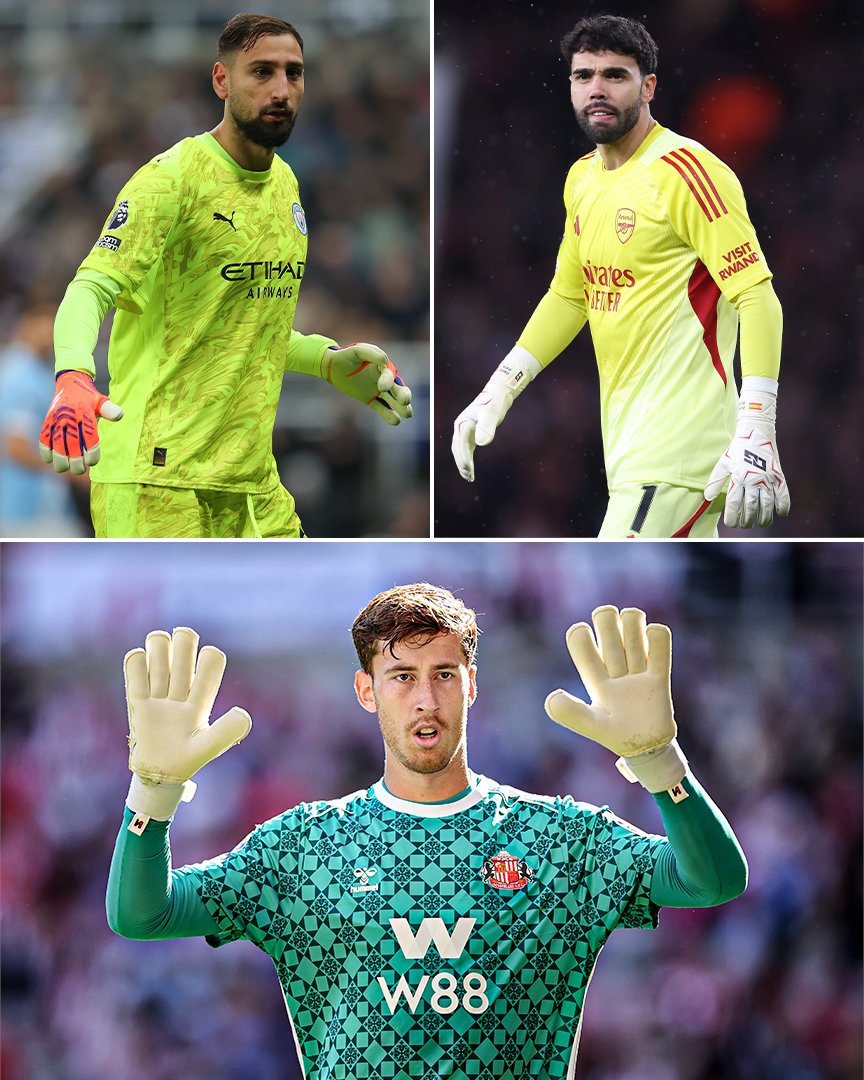
Premier League’s Stingiest Defenses Highlighted Amid Season of Goals
In a Premier League season that has delivered an avalanche of goals and relentless attacking football, only three clubs have managed to maintain remarkable defensive consistency: Arsenal, Manchester City, and Sunderland. While the league-wide average has soared to more than 2.8 goals per game, this trio has avoided any match in which they conceded more than two goals, a rare feat in modern English football where defensive frailty often makess.
Arsenal’s Defensive Masterclass Defines Their Title Ambitions
Arsenal’s evolution into one of the Premier League’s hardest teams to break down has been central to their continued challenge for the title. Under the meticulous guidance of their manager, the North London side has blended tactical control with defensive resilience. Their backline, featuring key figures such as William Saliba and Gabriel Magalhães, has developed into one of Europe’s most coherent defensive units.
The team’s defensive record has been built not only on individual prowess but on structure. Arsenal’s high pressing system, refined over recent seasons, forces opponents into rushed decisions and careless turnovers. Moreover, the full-backs’ dual responsibility of attacking support and defensive recovery has provided balance, allowing the central defenders to maintain shape. This tactical discipline has resulted in numerous clean sheets and narrow victories, emblematic of a mature title-contending side.
Historically, Arsenal’s defensive stability recalls their legendary backlines of the late 1990s and early 2000s that helped secure domestic dominance. Then, figures such as Tony Adams and Sol Campbell set the standard for defensive excellence. Although today’s Arsenal operates in a vastly different tactical environment, the underlying principle remains: championship runs are built on strong defensive foundations.
Economically, Arsenal’s rise as a defensively dominant side adds commercial appeal. A title-contending team draws substantial revenue from broadcasting rights, merchandising, and international fan engagement, vital for sustaining long-term competitiveness in English football’s top tier.
Manchester City’s Possession Control as a Defensive Weapon
Manchester City’s defensive record comes as little surprise given their hallmark possession-oriented style under their celebrated manager. While City may appear to prioritize attacking fluidity, their control of possession serves as the foundation of their defensive solidity. With the ball rarely leaving their feet, opponents find few openings to exploit.
This strategic dominance is not accidental but deeply ingrained within City’s footballing philosophy. The team’s defenders, including Ruben Dias and Josko Gvardiol, are comfortable on the ball, capable of turning defense into attack seamlessly. Meanwhile, Rodri’s presence as a midfield anchor acts as a bulwark before the backline, frustrating opposition counterattacks. The result is a system in which defensive breakdowns are minimized through proactive control rather than reactive tackling.
Manchester City’s approach reflects a broader historical shift in English football, where possession has become a defensive tool as much as an attacking one. Two decades ago, teams typically prioritized physicality and deep-line defending to stifle opponents. Today, City’s blueprint demonstrates how control of tempo and territory can serve the same purpose, effectively neutralizing opponents' offensive momentum.
Financially, City’s sustained dominance continues to influence the Premier League’s economic hierarchy. Their stability at the back contributes directly to success on all fronts, ensuring the club’s consistent qualification for international competitions and the associated financial windfalls that follow.
Sunderland’s Unexpected Resilience Against the Odds
Perhaps the most astonishing inclusion in this defensive trio is Sunderland, a club currently grappling with the reality of relegation struggles. Despite facing technically superior sides almost weekly, Sunderland’s defense has performed with exceptional organization and grit. Limiting damage in defeats and holding top teams to narrow scorelines has become their hallmark in an otherwise challenging campaign.
This defensive consistency can be traced to the tactical acumen of their manager, who has implemented a disciplined shape compact in midfield and unforgiving in the penalty area. While Sunderland’s attack has struggled for output, their ability to remain competitive owes much to their defenders’ positioning awareness and the goalkeeper’s leadership at the back.
Historically, Sunderland has oscillated between the top and lower divisions, with resilience forming part of their identity. This season’s defensive determination evokes the club’s gritty mid-2000s campaigns, when they relied heavily on organization and work ethic to compete with wealthier rivals. While relegation remains a looming threat, the structure Sunderland has established could serve as a foundation for rebuilding in future seasons.
From an economic and sporting perspective, Sunderland’s defensive displays bring value beyond the immediate results. Staying competitive against giants of the Premier League helps maintain fan engagement, matchday revenue, and player market value—crucial metrics for a club fighting to sustain itself in the top division.
A League of Goals but a Few Masters of Defense
This Premier League season has witnessed a surge of attacking play, driven by innovative tactics, advanced analytics, and attacking depth across most clubs. Teams now prioritize forward motion, frequently fielding multiple playmakers and full-backs who operate more like wingers. Consequently, defenses have been stretched thin, leading to a spike in goal averages unseen in over a decade.
Against that backdrop, Arsenal, Manchester City, and Sunderland’s defensive achievements stand out for their rarity. Across the past twenty Premier League seasons, only a handful of teams have managed to avoid heavy defeats throughout an entire campaign. In the 2003–04 “Invincibles” season, Arsenal famously went unbeaten, while Chelsea’s 2004–05 defense, marshaled by John Terry and Ricardo Carvalho, conceded just 15 goals all season—an enduring benchmark. Those examples underline how defensive impenetrability often coincides with historical success or admirable team cohesion.
By comparison, this year’s league has featured multiple high-scoring blowouts involving traditionally competitive sides. That makes the current trio’s consistency even more impressive. While such results may not always translate directly to trophies or survival, defensive pride remains a defining characteristic of elite teams.
Tactical Evolution and Trends
Modern football’s defensive trends emphasize versatility over rigidity. Today’s defenders are expected to initiate attacks, contribute to buildup play, and switch positions naturally within fluid systems. Arsenal and Manchester City exemplify this shift. Their defensive strength is not a result of deep blocks, but of control higher up the pitch, reducing oppositions’ opportunities before they materialize.
Sunderland’s model differs. Lacking the investment of larger clubs, they have embraced compactness. Their defensive formation relies on minimizing spaces and forcing opponents into low-percentage chances. It is an approach reminiscent of Leicester City’s 2015–16 miracle run, when disciplined positioning made them nearly impossible to break down despite long spells without possession.
The contrast illustrates how multiple paths to defensive stability exist within the Premier League’s tactical landscape. Whether through dominance of the ball or disciplined structure, these methods all serve one purpose: reducing risk.
Economic and Statistical Perspective
Defensive performance in modern football carries measurable financial implications. Clubs with strong defenses often experience greater consistency in results, which correlates directly with revenue from higher league finishes, cup progression, and international qualification. Over the past five years, the correlation between defensive record and total points in the Premier League has been striking: nearly 70 percent of top-four finishers conceded fewer than 38 goals across the campaign.
Arsenal and Manchester City’s defensive resilience reflects both sporting excellence and sustained investment. The resources poured into scouting, analytics, and tactical expertise have transformed their defensive profiles, turning specific philosophies into profitable structures.
Sunderland’s case underscores another reality: for smaller clubs, strong defensive organization can act as an economic equalizer. By minimizing losses, they enhance their competitiveness and safeguard television and sponsorship income. Even if relegation ultimately occurs, a reputation for defensive dependability can attract attention from larger clubs, providing transfer revenue and financial stability amid turbulent times.
Regional and Historical Comparisons
Across Europe’s top leagues, similar defensive trends emerge. In Spain’s La Liga, teams like Real Madrid and Girona have built title runs on balance between attack and defense, while in Italy’s Serie A, Inter Milan’s compact formation mirrors elements of Sunderland’s tactical discipline. Meanwhile, in Germany’s Bundesliga, Bayern Munich’s pressing system shares City’s emphasis on control as a preventive measure.
Comparative analysis highlights how the Premier League continues to blend the best tactical elements from around Europe, producing a hybrid footballing culture. This globalization of football ideas has enriched the league, but it also places enormous defensive demands on every team. To thrive in such an environment, maintaining discipline over 90 minutes and across 38 games requires not just talent but profound tactical identity.
The Broader Significance
As the season approaches its conclusion, the value of defensive consistency cannot be overstated. While goals draw attention, titles and survival often depend on defensive reliability. Arsenal and Manchester City’s ability to limit damage has kept them within striking distance of the league’s top positions. Sunderland, on the other hand, has used defensive fortitude to maintain dignity and competitiveness in adversity.
In a year when offensive fireworks dominate analysis, these three clubs demonstrate that defense remains the quiet cornerstone of footballing success. Their discipline amidst chaos offers both a statistical anomaly and a timeless reminder that even in the modern game’s ever-evolving tactical landscape, the old adage still holds: strong defenses win championships—or at least, keep dreams alive.