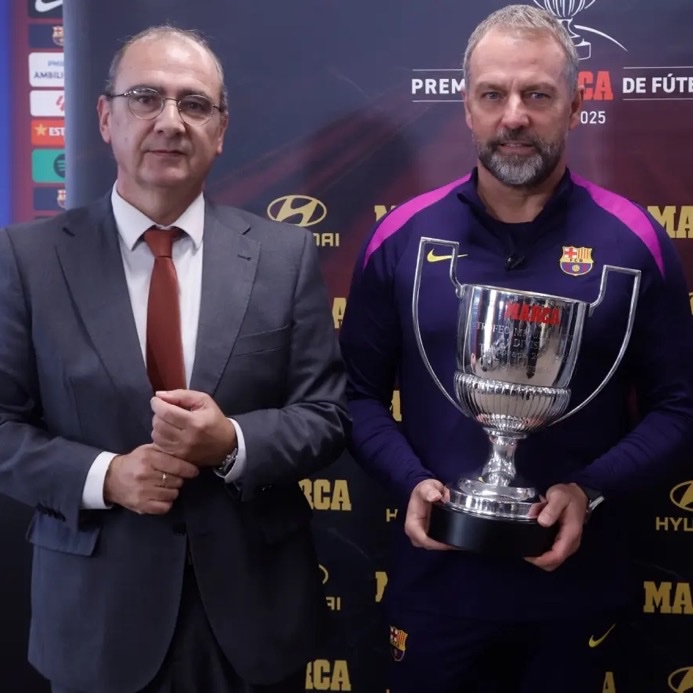
Hansi Flick Named 2025 MARCA Trophy Winner as Best Coach in Spanish Football
Hansi Flick, head coach of FC Barcelona, has been awarded the 2025 MARCA Trophy, recognizing him as the best coach in Spanish football. The prestigious honor follows a stellar 2024–25 season marked by tactical excellence, player development, and a revitalization of Barcelona’s competitive spirit across domestic and European competitions.
Flick’s First Full Season Brings Barcelona Revival
The German tactician took charge of Barcelona in the summer of 2024 with the monumental task of returning the club to the summit of Spanish and European football. Coming off several transitional seasons following the departures of key players and managerial instability, Barcelona needed both results and identity.
Flick delivered on both counts. His disciplined yet dynamic approach fused the traditional possession-based style associated with Barcelona with the efficiency and pressing intensity that defined his past successes at Bayern Munich and with the German national team.
Under his management, Barcelona reclaimed a dominant presence in La Liga, consistently challenging Real Madrid and Atlético Madrid week after week. The squad’s renewed discipline and creativity were reflected in both their high defensive line and attacking fluidity, hallmarks of Flick’s system.
Tactical Transformation Yields Results
Flick’s Barcelona blended tactical familiarity with new ideas. His preference for a 4-2-3-1 formation allowed young stars such as Pedri, Gavi, and Lamine Yamal to flourish in attacking roles while balancing defensive solidity. This structure gave the midfield renewed control and fluid transitions that proved crucial in tight matches.
The emphasis on pressing and rapid ball recovery also signaled a shift away from the more passive control that had characterized previous regimes. The result was a higher tempo, increased ball recoveries, and an energetic approach that fans quickly embraced.
Perhaps one of the most notable aspects of Flick’s success was his ability to extract consistency from a restructured defense. In a league often defined by its attacking flair, Barcelona’s defensive record stood out among the best, with Marc-André ter Stegen once again performing as one of Europe’s top goalkeepers.
A Season of Redemption in Domestic Competitions
The MARCA Trophy recognizes coaching achievements that extend beyond match victories, valuing leadership, innovation, and long-term influence on team performance. Flick’s leadership embodied all three.
Barcelona’s season featured memorable wins against archrivals Real Madrid in both La Liga and the Spanish Super Cup, moments that reinvigorated supporters and strengthened belief in Flick’s project. His rotation management and trust in youth players such as Fermín López and Pau Cubarsí reflected his long-term vision of balancing experience with emerging talent.
While narrowly missing out on a deep Champions League run, the consistency shown across domestic competitions underscored a team on a clear upward trajectory. The MARCA committee’s decision to honor Flick was seen as a recognition not only of results but of revived identity and purpose within one of football’s most storied clubs.
German Precision Meets Catalan Spirit
Hansi Flick’s arrival marked a rare instance of a foreign manager seamlessly integrating into Barcelona’s distinct footballing culture. The connection between the Catalan club’s identity and Flick’s methodical approach created a compelling synergy.
Observers across Spain have pointed to how his analytical preparation, focus on pressing structure, and adaptability have reinvigorated the concept of “total football” in a modern context. By blending positional play—long a Barcelona trademark—with German efficiency, Flick constructed a team that could both entertain and compete relentlessly.
His attention to detail, from set-piece routines to in-game tactical tweaks, earned admiration even from rivals. Spanish football pundits credited him with restoring Barcelona’s aura of control, noting how his sides could dominate possession without sacrificing vertical threat.
Historical Context: Linking Past and Present Success
Barcelona has a long tradition of foreign managers influencing its evolution, from Johan Cruyff’s revolutionary “Dream Team” era to Pep Guardiola’s global domination. Flick’s success connects to that lineage, though his methodology stems from the pressing culture of modern German football rather than solely from the positional traditions of La Masia.
Before Flick, the last few seasons had seen Barcelona struggle to maintain identity amid financial instability and managerial turnover. The MARCA Trophy now places Flick among the few non-Spanish coaches to have earned the award—joining names such as Louis van Gaal and Frank Rijkaard—each of whom guided transitional squads toward a new golden period.
In historical perspective, such recognition often serves as a precursor to enduring success. When Rijkaard first reestablished Barcelona in the early 2000s, the foundations were laid for the Guardiola era. Flick’s recognition could mark the start of a comparable resurgence, albeit in a new competitive environment defined by tightened financial rules and greater league parity.
Economic Impact and Club Rejuvenation
Beyond sporting implications, Flick’s success carries notable economic and commercial reverberations. Barcelona’s improved form has increased matchday revenue, merchandising sales, and international engagement, critical for a club navigating strict La Liga financial controls and long-term debt restructuring.
The team’s consistent performances renewed global sponsor confidence, attracting new commercial partnerships and helping stabilize what had been a turbulent financial period. Increased ticket demand at the temporary Montjuïc Stadium, as Camp Nou renovations continue, signaled growing fan optimism about the club’s immediate future.
Experts suggest that success on the pitch also influences youth retention and academy morale. Prospects see a clearer path to senior football under Flick’s guidance, preserving the institution’s core philosophy of developing homegrown talent. This alignment between sporting and financial recovery has strengthened Barcelona’s strategic position in both domestic and European contexts.
Wider Implications for Spanish Football
Flick’s recognition as the best coach in Spanish football also reflects the league’s growing diversity of tactical ideas. La Liga, traditionally dominated by Spanish managers emphasizing possession and technical mastery, has become an evolving tactical landscape featuring more aggressive pressing systems and hybrid formations.
In recent years, foreign coaches such as Diego Simeone, Carlo Ancelotti, and now Flick have reshaped strategic trends in Spain. Their influence has sparked discussion around the league’s modernization, as teams seek a balance between stylistic heritage and tactical innovation.
Comparatively, the German influence in Spain remains a rarity. Flick’s success may encourage further cross-cultural coaching exchanges, signaling that adaptability and analytical rigor are increasingly vital tools for succeeding in contemporary European football.
Reaction from Barcelona and the Football Community
Fans and pundits alike greeted Flick’s MARCA Trophy win with enthusiasm. Barcelona’s sporting director lauded the coach for restoring the team’s “competitive DNA,” while players openly credited his transparent communication and relentless training standards for their progress.
Spanish media outlets highlighted his dedication to footballing detail, describing how his sessions often integrate technology and data analysis, mirroring methods that helped him win the UEFA Champions League with Bayern Munich in 2020.
Reactions from rival managers also reflected respect. Ancelotti called Flick “an architect of a modern Barcelona revival,” while Atlético’s Diego Simeone referred to him as “a competitor who makes everyone raise their level.”
Looking Ahead: Sustaining Success Beyond the Trophy
Winning the 2025 MARCA Trophy solidifies Flick’s standing among Europe’s elite coaches, but it also raises expectations for what comes next. Barcelona’s ambitions include reclaiming the Champions League and establishing stability in domestic dominance.
The biggest challenge now lies in maintaining balance as fixture congestion intensifies and player development remains a long-term priority. Flick’s track record suggests commitment to evolving tactics season by season—a necessity for sustained success in an era where analytical preparation and squad depth define top-level outcomes.
As Barcelona approaches another competitive cycle, Flick’s MARCA Trophy stands as both acknowledgment and motivation. It symbolizes a year in which structure, identity, and belief coalesced under a single vision. For a club long defined by its pursuit of excellence, that combination may prove as valuable as any trophy lifted on the pitch.
Conclusion: A Defining Moment for Barcelona and La Liga
Hansi Flick’s recognition as Spain’s best coach of 2025 transcends individual achievement. It marks the culmination of a carefully planned managerial project that revived one of the world’s most iconic football institutions. His impact extends beyond Camp Nou, influencing Spanish football’s tactical dialogue and reaffirming that adaptation and innovation remain at the heart of progress.
For Barcelona, the MARCA Trophy represents more than a seasonal accolade—it captures a turning point. In the evolving narrative of European football, Flick’s disciplined artistry has once again proven that clarity of vision can rebuild legacy, inspire players, and win not just matches, but the trust of fans worldwide.