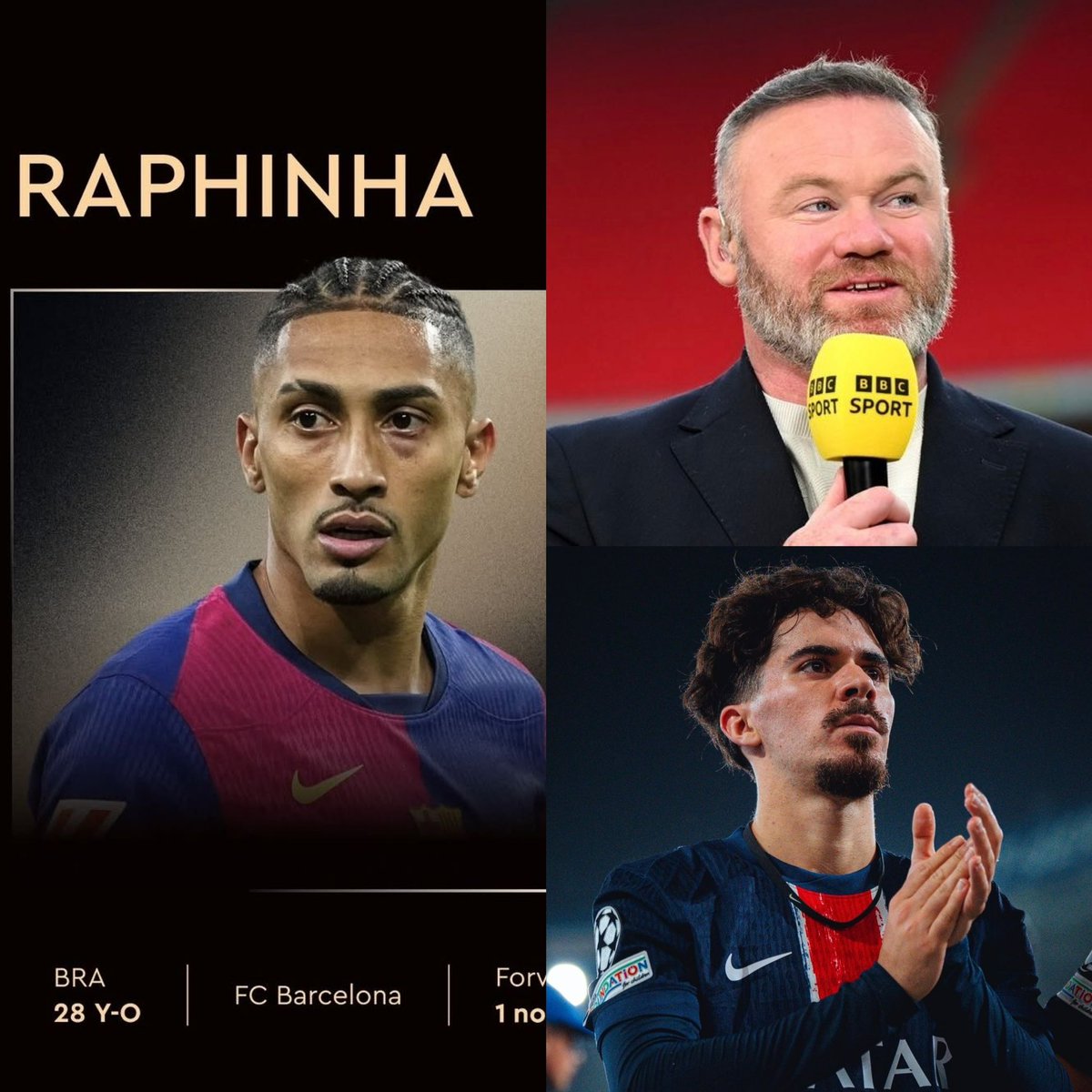
Wayne Rooney Criticizes 2025 Ballon d’Or Rankings, Defends Raphinha’s Case for Top Spot
Former England striker Wayne Rooney has reignited debate over the 2025 Ballon d’Or rankings by questioning why Barcelona winger Raphinha placed only fifth despite a record-breaking season. Rooney argued that the Brazilian forward was deserving of the number one position, citing his remarkable 59 goal contributions in 57 matches across all competitions. His pointed comments, contrasting Raphinha’s achievements with the third-place finish of Paris Saint-Germain midfielder Vitinha, have sparked passionate debate among fans, pundits, and former professionals.
Rooney’s Defense of Raphinha
Rooney’s remarks came during a football broadcast, where he underscored Raphinha’s influence at Barcelona during a season burdened with injuries and transitions. He pointed to the winger’s unparalleled consistency in both domestic and European competitions.
"Raphinha produced numbers that you rarely see in modern football, and it wasn’t just about goals and assists—it was about moments of absolute necessity," Rooney remarked. "He carried Barcelona in tight games, showed heart, and proved himself over and over. For me, he deserved the Ballon d’Or."
The 33-year-old attacker not only delivered record-breaking statistics but also displayed clutch performances in high-pressure matches—including decisive goals in the UEFA Champions League knockout rounds and La Liga title race. Many supporters have echoed Rooney’s sentiments online, suggesting that the Brazilian’s production and leadership should have weighed heavier in the voting process.
The Case for Vitinha
Rooney’s critique drew sharp contrast with Vitinha, who finished third after playing a key role in PSG’s historic treble-winning season. The Portuguese midfielder was instrumental in balancing PSG’s midfield, providing defensive cover while orchestrating build-up play. His contributions were lauded for enabling star forwards Kylian Mbappé and Ousmane Dembélé to flourish in attack.
While acknowledging Vitinha’s successful year, Rooney indicated that his recognition may have come more from team triumphs than individual brilliance. "Vitinha was excellent and deserves praise, but when you compare individual influence, I think Raphinha did more to single-handedly elevate his team," Rooney added.
Fan Reactions and Online Debate
The comments have quickly divided the football community. Supporters of Barcelona insist that Raphinha was snubbed by voters who favored trophy winners from larger markets or more glamorous lineups. Many pointed to previous instances of Ballon d’Or controversies, such as Wesley Sneijder’s omission in 2010 despite leading Inter Milan to a treble, or Robert Lewandowski missing out in 2020 when the award was canceled.
On the other hand, PSG fans and neutrals contend that Vitinha’s steady leadership and ability to dictate matches in the Champions League labeled him indispensable. They argue that true greatness is measured not only by personal numbers but also by contributions to winning major silverware.
The debate hints at the broader philosophical question that has long surrounded the Ballon d’Or: should it reward sheer statistical dominance, or prioritize influence on teams that win the most prestigious tournaments?
Historical Context of Ballon d’Or Controversies
The Ballon d’Or, awarded annually since 1956, has seen several contentious decisions dividing football purists and fans alike. Over decades, the award has often sparked debate over whether attackers are unfairly favored due to their visible scoring contributions, while midfielders and defenders sometimes go underappreciated despite crucial roles in team success.
In 2006, Italian defender Fabio Cannavaro earned the prize after leading his nation to a World Cup victory, sparking criticism from those who believed stars like Ronaldinho or Thierry Henry had stronger club resumes. Similarly, in 2013, Cristiano Ronaldo secured his second Ballon d’Or in a year where Franck Ribéry’s treble-winning performances at Bayern Munich were largely overshadowed.
Raphinha’s supporters now argue that his fifth-place finish mirrors such historical injustices, where players outside the predetermined shortlist of global icons struggle for the recognition their statistics seem to demand.
Barcelona’s Resurgence and Economic Impact
Beyond the personal accolades, Raphinha’s season has had ripple effects for FC Barcelona during a challenging financial chapter in its history. The Catalan giants have battled wage cap regulations, mounting debt, and the aftereffects of Lionel Messi’s departure in 2021. Yet Raphinha’s performances brought international attention back to the club, energizing supporters and boosting Barcelona’s domestic brand strength.
Merchandise sales involving the Brazilian forward reportedly spiked throughout the season, with jersey and endorsement revenues helping the club offset some of its wider economic woes. His elevated profile also coincided with Barcelona’s return to the latter stages of the Champions League, ensuring higher broadcasting revenues and renewed global relevance.
For a club that has endured questions about whether it could still attract elite talent, Raphinha’s rise represents a timely reminder of Barcelona’s ability to nurture stars capable of rivaling Europe’s best.
Regional Comparisons and Broader Implications
When comparing La Liga and Ligue 1, analysts point out that individual statistics such as Raphinha’s are often harder to achieve consistently in Spain. La Liga is known for its tactical rigidity, defensive resilience, and greater parity among mid-table teams. In contrast, Ligue 1 is often characterized by PSG’s dominance, allowing their stars more opportunity to shine collectively rather than individually.
This is not to diminish Vitinha’s season, but Rooney’s assertion highlights deeper differences in European football structures. Players thriving in Spain or Italy often receive heightened recognition when their achievements break through known defensive leagues.
Looking back, similar debates unfolded when Luka Modrić won the 2018 Ballon d’Or after a Champions League title and World Cup final appearance, despite Lionel Messi and Cristiano Ronaldo registering more than 50 goal contributions each. Analysts then argued that contribution to team achievement outweighed raw numbers, creating an evergreen tension in evaluation criteria.
What the Debate Reveals About Modern Football
Rooney’s intervention underscores how the modern game increasingly grapples with metrics versus influence. Statistical analysis has grown central to judging performances, but moments of “clutch play” and visible leadership remain harder to quantify.
Ballon d’Or voters are drawn from journalists, captains, and coaches—a system meant to blend objective assessment with subjective viewing. Yet as Rooney’s comments show, opinions about football greatness remain deeply polarized, rooted in personal philosophies as much as in data.
The ongoing discourse also reflects football’s shifting global balance. With more leagues rising in prominence and talent spread widely across Europe, arguments over who is most deserving are unlikely to disappear anytime soon.
Looking Ahead
Whether Raphinha can build on his breakout year remains a pivotal storyline for the 2025–26 season. Barcelona faces pressure to return to the summit of European football, while PSG will seek to maintain momentum after their historic treble. Both Vitinha and Raphinha are now entrenched in the global spotlight, with every performance likely to reignite comparisons.
Rooney’s statements ensure that the 2025 Ballon d’Or will be remembered not only for its winners but for the storm of debate it created. As football continues to evolve, the clash between measurable success and intangible influence may define the award’s narrative for years to come.